
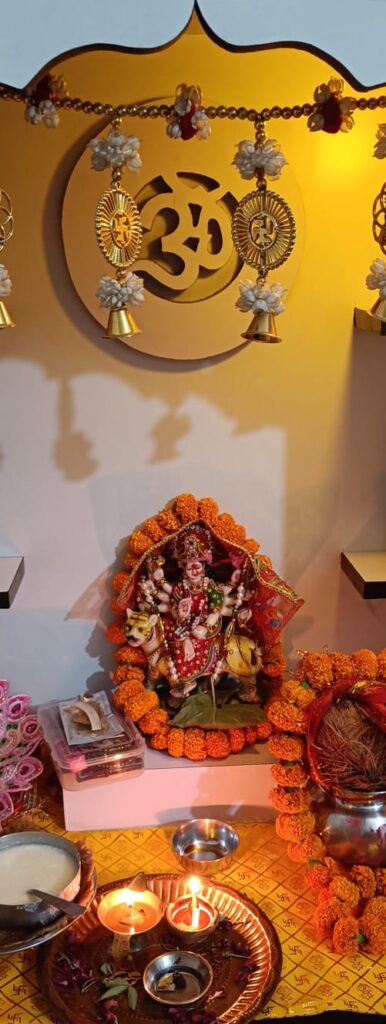
Today Navratri begins, and this morning I read something that struck me deeply. The diya we light in front of Maa’s murti is not just symbolic, it is fire itself, sakshaat Devi. Among the five elements, fire alone remains untouched, untainted, pure. It burns away all that is impure, leaving behind only what is purest of all: ashes.
This image has stayed with me, etched in my mind.
Because when you look closely, everything in motion is Shakti. Every breath, every thought, every experience, every spark of life. It is Her. She is not just in the murti we worship, She is the worship, the devotee, the murti, the flame, and the act of bowing. She is both the seen and the unseen.
During these nine days of Navratri, we are not simply honoring nine different forms of Devi. We are bowing down to the entire creation, to everything that moves, pulsates, vibrates, flows, within us and outside us. She is the life-force that animates everything. She is what is, to that which is not.
Vedant says all that exists is one — Brahman, the ultimate reality. Yet, this Brahman, though formless and beyond attributes, expresses itself in two fundamental ways: as the stillness of Shiva (pure consciousness) and as the movement of Shakti (the dynamic power of manifestation).
Think of it like this:
- Shiva is the canvas, silent, unchanging, infinite.
- Shakti is the painting, the brushstrokes, the colors, the very act of creation.
Without Shakti, Shiva is pure potential, unexpressed. Without Shiva, Shakti has no ground to arise from. They are not two — they are one, experienced differently.
When we see waves in the ocean, we call them waves. But are they separate from water? No. Similarly, everything we see as “life” is Shakti — yet inseparable from the stillness of Shiva, inseparable from Brahman itself.
She Is Everything
The rising sun — Shakti.
The river that flows — Shakti.
The fire that purifies — Shakti.
The body that breathes, the mind that thinks, the heart that feels — all Shakti.
She is the mother nurturing life.
She is the destroyer who clears away the old.
She is the very cycle of birth, sustenance, and dissolution.
In Advaita, the ultimate truth is that there is no second — no “me” separate from “Her.” The one who worships, the act of worship, and the deity worshipped are all Her play. The duality itself — of worshipper and worshipped — is dissolved in Her.
To recognize Shakti is to recognize that life itself is sacred. Every action, every thought, every sensation is Her expression. The dance of creation is not separate from the stillness of the Absolute.
The Flame Within
When we light a diya during Navratri, we are not just performing a ritual. We are invoking the eternal flame within ourselves — the Shakti that burns impurities of the mind, ego, and attachments. Just as fire leaves only pure ashes, Devi leaves us with only the essence — the Self that is untouched, unchanging, ever free.
And when we bow down during these nine days, we are not bowing only to a form. We are bowing to life itself. To the mother who flows as rivers, shines as the sun, nourishes as food, breathes as air, burns as fire, and stands steady as the earth.
She is the motion in the cosmos. She is the stillness that holds it. She is the one who creates, the one who sustains, the one who destroys, and the one who witnesses all of it.
Shakti is not outside you. She is you. She is me. She is the pulse in your veins, the thoughts in your mind, the love in your heart, the silence behind it all.
To worship Shakti is to worship existence itself.
To see Shakti is to see that everything is Her.
To surrender to Shakti is to realize that there was never anything other than Her.
Reading this got me goosebumps. Beautifully articulated.